
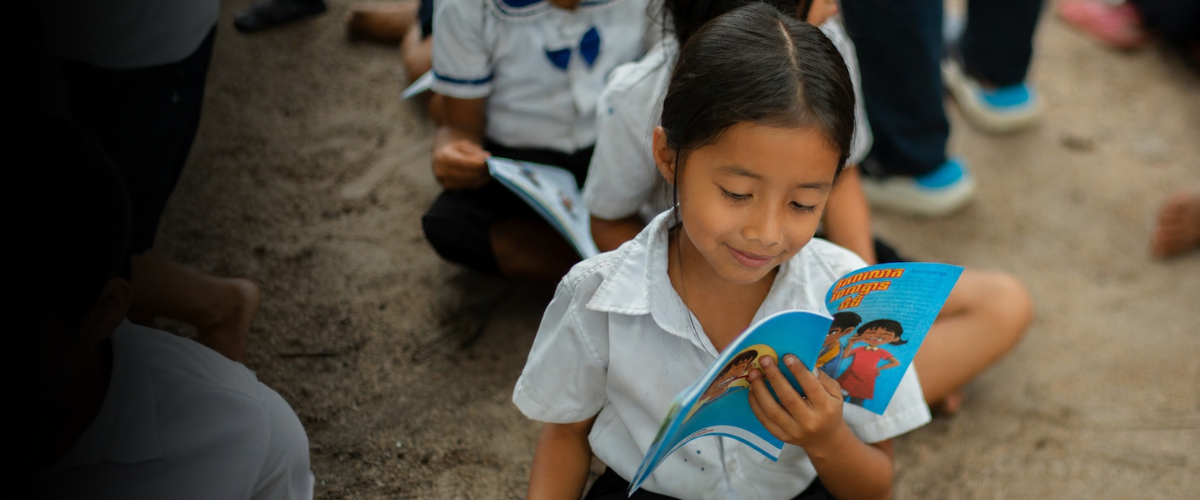
Every child grows up in a unique reality. For some, the greatest barriers to flourishing aren’t found in the headlines – they are the quiet, everyday challenges that shape whether they can learn, stay healthy, or even attend school.
Intestinal worms from contaminated soil. Cavities from never owning a toothbrush. Waterborne illnesses caused by unsafe drinking water. This has been the reality of millions of children in certain regions of the globe.
At OneHope, understanding those realities is where ministry begins. Rather than assuming what children need, OneHope listens carefully, studies their context, and develops Scripture engagement experiences that meet children where they are – addressing real-world challenges while introducing them to the hope of the Gospel.
Two Programs, One Insight
Working in different parts of the world, OneHope teams began noticing a common pattern. Children were facing practical health challenges that affected their ability to thrive, and local ministry partners expressed the same need: resources that cared for the whole child while pointing them to Jesus.
Though separated by geography, the teams were responding to the same insight. Physical well-being and spiritual transformation were not competing priorities – they could be meaningfully woven together.
In tropical regions of Africa, a program called Hygiene Matters was tackling one of the most widespread health challenges facing children: intestinal worm infections.
Before developing the program, OneHope researchers examined global evidence on child health interventions, consulted local partners, and designed curriculum around proven practices that could be adapted to local contexts. The result was more than a public health curriculum – Hygiene Matters was designed to create an experience that combined practical life skills with opportunities for children to encounter God’s Word. The curriculum was validated as part of a government-partnered deworming initiative in Togo, where nearly 2,600 students across 18 schools participated in evaluations before and after the program as part of a broader rollout reaching more than 73,000 students. Students demonstrated meaningful gains in hygiene knowledge, while teachers overwhelmingly affirmed the program’s value.
Rather than assuming success in one context would translate everywhere, OneHope validated the program by testing, measuring, and learning before expanding to additional countries.
Meanwhile, thousands of miles away in Cambodia, a new OneHope program called Smiles of Hope was helping children care for their teeth through practical oral health lessons, a new toothbrush, and a Book of Hope. An early evaluation, which gathered feedback from children, teachers, principals, and parents, found widespread enthusiasm. Among the program’s most memorable moments was a simple hands-on toothbrushing demonstration that children eagerly embraced.
The two teams weren’t working together to solve the same problem. One was addressing intestinal worms in Africa, while the other was promoting oral health in Cambodia. Yet, both arrived at the same realization: caring for a child’s physical well-being and introducing them to the hope of the Gospel didn’t have to be separate efforts.
That shared conviction laid the foundation for A World Without Sickness, a unified program that brought together the strongest elements of both initiatives through an assembly-style hygiene presentation and a six-lesson curriculum covering oral care, handwashing, latrine use, clean water, and the message of God’s love.
Putting It to the Test in Cambodia
Before scaling a merged program built from two different sources, OneHope needed to know: Would this new approach actually make a difference?
The first small-scale validation took place in a single church in Cambodia in 2017, surveying children before, during, and after the program.
Although the pilot involved a relatively small group of children, the results were encouraging. By the end of the program, more children understood each of the core Bible messages, and their knowledge of healthy hygiene practices had improved across most topics. Just as importantly, a greater percentage reported putting those lessons into practice in their daily lives. A reading assessment also confirmed that children could easily understand the Student Book and accurately answer comprehension questions.
The early findings gave OneHope confidence to keep moving forward.
What began with 125,000 children reached in Cambodia in 2017 quickly expanded. By 2020, A World Without Sickness was reaching 388,000 children across five countries in South and Southeast Asia, laying the groundwork for an even broader global rollout.
Listening and Learning in a Majority-Hindu Nation
For OneHope, research isn’t only about proving a program works – it’s about discovering how it can serve children better. Every validation creates another opportunity to listen, learn, and improve.
As A World Without Sickness expanded, OneHope continued asking an important question: How could the program become even more effective?
In 2021, researchers conducted a broader validation across five regions of a majority-Hindu nation in South Asia, gathering feedback from 193 children and youth, 89 program leaders, and 41 pastors. Rather than simply measuring outcomes, the study sought to understand how children, churches, and communities were actually experiencing the program.
The response was overwhelmingly positive:
- Nine out of ten children said they liked the lessons a lot
- 78% of children said they learned new things to help their health
- 71% of children said they learned new things about God or Jesus
- 85% of children, including the majority of Hindu and Buddhist participants, said they wanted to learn more.
- 83% of leaders said they’d recommend the program to other teachers, and 85% of pastors believed other churches in their area would want to use it too
But the evaluation also identified practical ways to strengthen the program. More than half of the children had some difficulty understanding certain words in the book, a pattern especially pronounced among Hindu and Buddhist children, pointing to a translation and localization opportunity. Leaders also noted that while flossing is a healthy habit, it wasn’t realistic in many of the communities where they served.
And the most common, almost charmingly practical piece of feedback from both leaders and pastors: send a bigger tube of toothpaste.
Testing the African Version
Two years later, as A World Without Sickness was being contextualized for African audiences, OneHope once again turned to research before expanding the program more broadly.
In 2023, the African version was piloted in Lesotho and Zambia, reaching 92 students across four schools. The results showed encouraging progress. Students demonstrated meaningful improvement across many of the Bible and health concepts being taught, and by the end of the program, more children reported practicing healthy hygiene habits at home.
Just as importantly, children connected with the program itself. Nearly three-quarters said the health lessons were easy to understand and that the Student Book felt “just right” for children their age. Participating teachers echoed that enthusiasm, saying they were very likely to recommend the program to others. As one teacher simply put it: “The program is awesome.”
From Two Pilots to a Global Program
Today, A World Without Sickness is active across every region of Africa, is widely used throughout South and Southeast Asia, and is beginning to expand into Latin America. Over the past five years alone, it has reached more than seven million children, with its greatest impact in some of the world’s hardest-to-reach communities, including majority Muslim, Hindu, and Buddhist nations where many children may otherwise have little opportunity to hear the name of Jesus.
It would be easy to see A World Without Sickness as simply a health program with a Bible lesson woven in. But one moment from that first validation in Cambodia captures the heart of the program.
After reading a passage about washing their hands, children were asked a simple question: “How does Jesus make us clean on the inside?”
Every child answered correctly: “Because He takes away our sin.”
That’s the vision that has shaped A World Without Sickness from the very beginning: a child learns to care for their body while discovering the One who makes all things new. Today, thanks to years of listening, testing, and refining, millions of children—including many who may otherwise never hear the name of Jesus—are experiencing that same transformation.
Sometimes, changing the world begins with something as simple as a bar of soap, a toothbrush, and the life-changing message of God’s love.
Share this story to celebrate how practical acts of care are opening doors for children around the world to encounter the hope of Jesus!
-
OneHope Team
- 28 Oct 2026
Is Gen Alpha Really the Same Around the World?
From digital habits and family relationships to faith and spirituality, OneHope’s growing global research reveals what connects Gen Alpha across…
-
- 28 Sep 2026
Growing Up on Mars: How to Reach an Anxious Generation
Imagine someone offered to send your ten-year-old to grow up on Mars.The trip is safe, they promise. The technology works.…


Leave a Reply